

Results
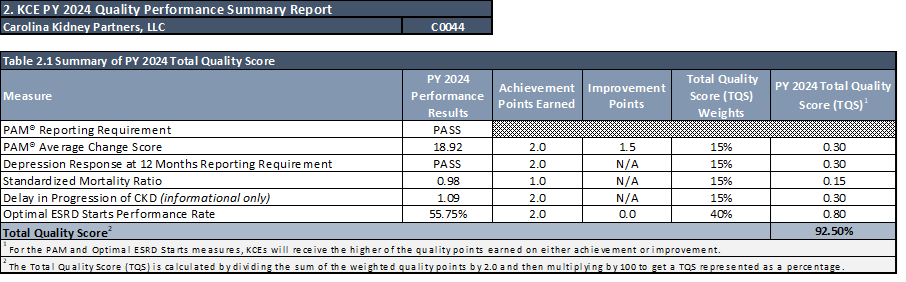
89.17%
Average Total Quality Score since 2022 ️
PY2024 Total Quality Score
92.50%
Most Recent Performance Year Results (PY2024)
Delay in Progression of CKD
1.09 (Maximum Points Earned)
Official PY2024 CMS Optimal ESRD Starts Performance Rate
55.75% (Maximum Points Earned)
1st —> 2nd PAM Survey Average Change Score
18.92 (Maximum Points Earned)
PAM Survey Reporting Requirement
PASS ️✅
Depression Response at 12 Months Reporting Requirement
PASS ️✅
-
Model Option Risk Track: Professional Track
Performance Status: Generated Shared Savings
Net Shared Savings Amount:($362,020.57)
Allocation of Earned Shared Savings:
50% Reinvested in Patient Care & Innovation: This entire allocation was directed back into our core infrastructure, redesigned clinical care processes, predictive data platforms, and preventive resources necessary to improve patient health outcomes and lower overall Medicare expenditures.
50% Distributed to Clinical Partners: This portion was distributed among our participating network nephrology practices and preferred provider clinical stakeholders to reward value-based care execution.
Historical Overview:
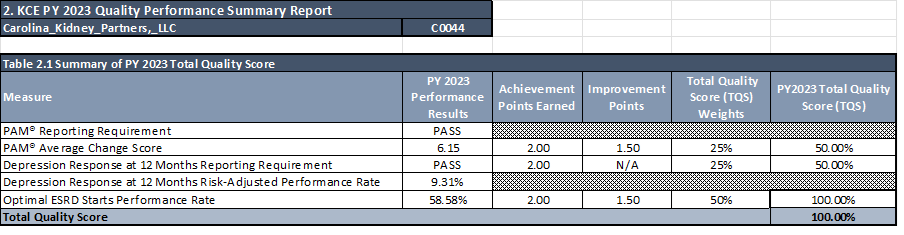
Performance Year 2023: $931,292.54 Shared Savings
Performance Year 2022: $0 Shared Savings
📊 2024 TQS Detail
📊 2023 TQS Detail
📊 2022 TQS Detail


As of 2021, 15% of adults in the U.S. are estimated to have CKD
The stakes have never been higher when it comes to treating chronic kidney disease (CKD). 15% of adults in the United States have chronic kidney disease.
With a growing network of locations and over 120 providers, Carolina Kidney Partners ensures that patients get the care they need when they need it. Regardless of stage or prognosis, Carolina Kidney Partners helps patients navigate the system and offers a wealth of tailored support and services focused on better health outcomes.
Carolina Kidney Partners strives to do more than treat chronic kidney disease. We hope to prevent it. Our state-of-the-art predictive analytics system identifies patients who may be at risk for progression of kidney disease, which allows us to focus resources on prevention rather than treatment.